

Killer Deal
If the most prolific serial killer in U.S. history didn’t get the death penalty, who should?

Ironically, it may be the United States’ most notorious serial killer that puts an end to the death penalty in Washington state. not that that was Gary Ridgway’s intention when his attorneys approached king county prosecutor Norm Maleng (JD ’66) in April of 2003 with a deal: take the death penalty off the table, and Ridgway would take responsibility for the vast number of murders attributed to the Green River killer.
It’s that deal that is inspiring debate among legal scholars, the general public and attorneys throughout the state. The question is a matter of fairness, or, more technically, a question of proportionality.
It was in 1972 that Furman v. Georgia overturned the death penalty in nearly every state based on what justice Stewart described as its wanton and freakish imposition. To the justices’ minds the death penalty was being imposed in a manner beyond merely reckless, but in a manner that unreasonably, perhaps even maliciously, risked harm, and did so with utter indifference to the consequences. Because the death penalty was being arbitrarily applied it was unconstitutional.
To reinstate capital punishment in Washington, the state needed to establish a system that would make the death penalty operate in some predictable manner. They revised statutes, limiting the death penalty to only those convicted of aggravated first-degree murder, and bifurcated the trial to prevent a jury’s verdict on guilt or innocence from being corrupted by evidence about the penalty. The state also provided for automatic review by the Supreme Court of Washington in which the court was to determine whether a conviction was supported by the evidence; whether or not execution was appropriate; and if, when compared to other persons convicted of aggravated murder, the sentence was excessive or disproportionate to the penalty imposed in other cases, considering the crime and the defendant. The state’s aim was to ensure that it was selecting for execution the most egregious perpetrators from the population of people who commit aggravated murder.

Proportionality review, though, means that both the circumstances of the crimes and criminal history of everyone ever convicted of aggravated first degree murder is open for comparison. Including Gary Ridgway. When convict-ed murders faced a sentence review in the past, they were likely to argue they weren’t as bad as everyone else who got the death penalty; as of Nov. 5, 2003, they’re likely to argue the opposite.
“Now people are going to be saying ‘I’m not as bad as somebody who didn’t get the death penalty. How can I get the death penalty if Gary Ridgway didn’t?’ and I think there is not a very good answer to that,” says John Junker, professor of law at the UW School of Law. “The difficulty with how the courts are going to handle the problem is that it seems like, if you say ‘you’re right’ to any defen-dant, you have to say that to all of them. Because it is unlikely there is anybody who can out kill Gary Ridgway. The problem with that is that, in effect, it is a repeal of the death penalty, a result that many would be in favor of, but it’s a hell of a way to run a democracy.”
To many, this begs the question of why a prosecutor would agree to a plea that could potentially have such a major impact on the state’s legal system. For King County Prosecuting Attorney Norm Maleng (’66), the Ridgway plea was about justice for the victims, healing the community, and closing out a massive number of unsolved crimes.
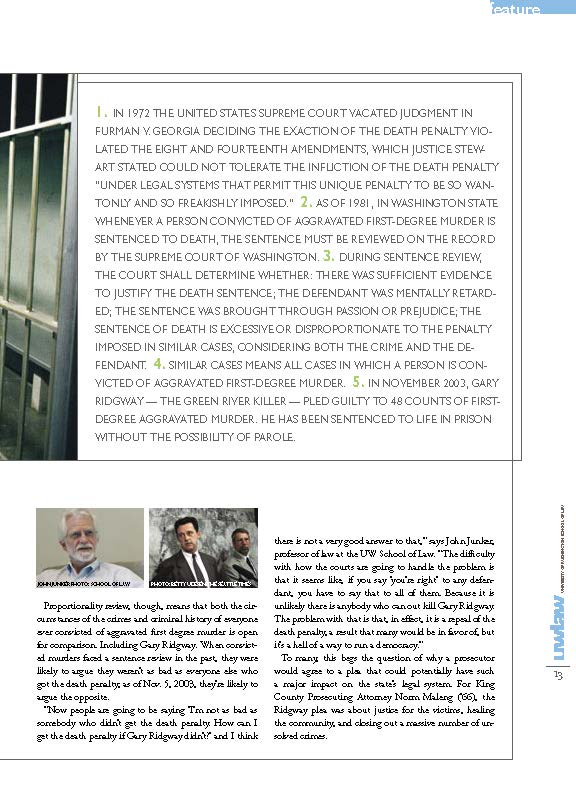
When, in April 2003, defense attorneys approached Maleng and put forward a proposal of a guilty plea in exchange for withdrawal of the death penalty, the prosecutor balked. He had already stated he would not plea bargain, and had filed a notice to seek the death penalty in which he claimed there were not sufficient mitigating circumstances to remove the option of death from the jury. But there it was: an opportunity to close so many unsolved cases, to give some relief to families left behind.
“My heart cried out, I didn’t say anything at the time, but my heart cried out ‘no!’ how could you ever consider set-ting aside the death penalty in a case involving potentially one of the most prolific killers in the history of the United States?” Maleng says of the proposal. “In other words, if any case was deserving of consideration of the death penalty by a jury, it was this case. And so my heart really cried out ‘no!’ However, I did know at the time I had to take this offer seriously.”
He knew the offer required a great deal of consideration because he also knew what he was up against. At the time lawyers approached Maleng with the proposal, the county had charged only seven cases. Without the necessary evi-dence to link Ridgway to any of the other 41 murders he was suspected in, and without any sort of admission of guilt, the prosecutor’s office could go no further. If pros-ecutors wanted to hold him accountable for the full range of victims — women Maleng felt had become marginal-ized, labeled and never really considered as human beings independent of their murder — he would have to enter into the plea agreement. Accepting the plea would also mean police and prosecutors could close investigations into open murders, or, where necessary, renew efforts in unsolved cases.
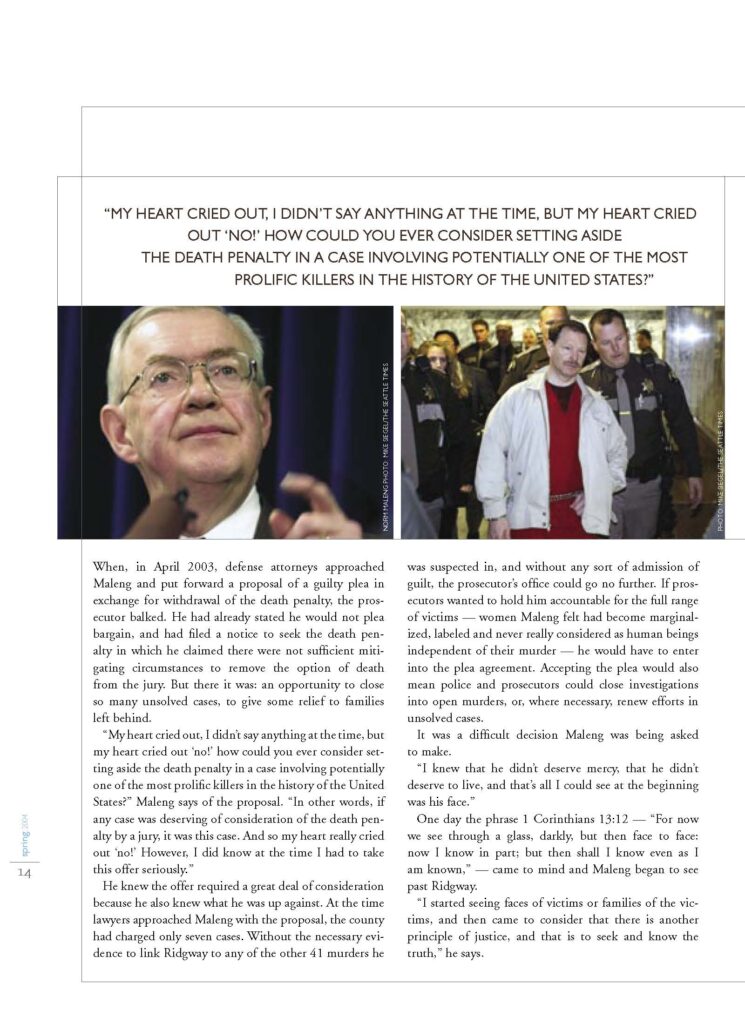
It was a difficult decision Maleng was being asked to make.
“I knew that he didn’t deserve mercy, that he didn’t deserve to live, and that’s all I could see at the beginning was his face.”
One day the phrase 1 Corinthians 13:12 — “For now we see through a glass, darkly, but then face to face: now I know in part; but then shall I know even as I am known,” — came to mind and Maleng began to see past Ridgway.
“I started seeing faces of victims or families of the victims, and then came to consider that there is another principle of justice, and that is to seek and know the truth,” he says.
With that in mind, and confident that his decision would not affect the state of the death penalty in Washington, he accepted the deal and Ridgway plead guilty to 48 counts of aggravated murder. Maleng is clear, the reason he accepted the plea was justice for the victims and their families. Unlike Junker and others, he doesn’t believe the Ridgway plea will have an affect on the death penalty. A self-described advocate of capital punishment, Maleng feels that principled decisions are what will keep the death penalty from excessive scrutiny by judges.
“What the courts are going to require is this: they’re going to require that we make principled decisions, that we don’t make decisions on the basis of race or gender, or those sorts of things, that we make principled decisions. And I believe that this case doesn’t really inform us in terms of other cases because we had a principle of justice that was applied here and when we get over on another case we’ve got to look at that case independently of the Ridgway case,” he says.
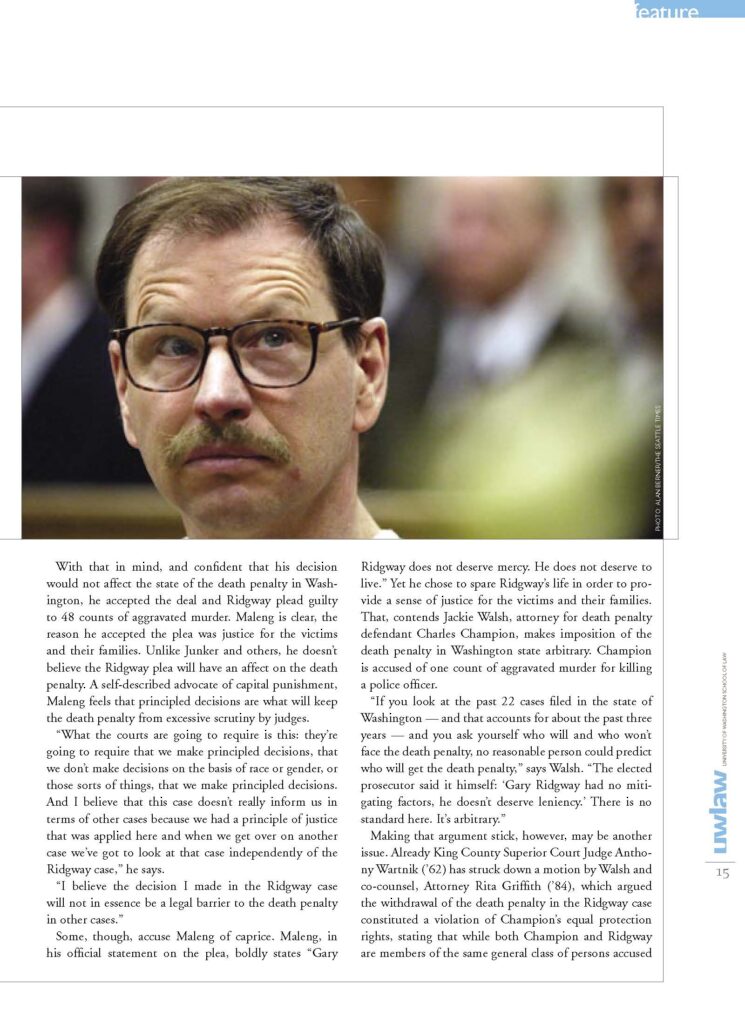
“I believe the decision I made in the Ridgway case will not in essence be a legal barrier to the death penalty in other cases.”
Some, though, accuse Maleng of caprice. Maleng, in his official statement on the plea, boldly states “Gary Ridgway does not deserve mercy. He does not deserve to live.” Yet he chose to spare Ridgway’s life in order to provide a sense of justice for the victims and their families. That, contends Jackie Walsh, attorney for death penalty defendant Charles Champion, makes imposition of the death penalty in Washington state arbitrary. Champion is accused of one count of aggravated murder for killing a police officer.
“If you look at the past 22 cases filed in the state of Washington — and that accounts for about the past three years — and you ask yourself who will and who won’t face the death penalty, no reasonable person could predict who will get the death penalty,” says Walsh. “The elected prosecutor said it himself: ‘Gary Ridgway had no mitigating factors, he doesn’t deserve leniency.’ There is no standard here. It’s arbitrary.”
Making that argument stick, however, may be another issue. Already King County Superior Court Judge Anthony Wartnik (’62) has struck down a motion by Walsh and co-counsel, Attorney Rita Griffith (’84), which argued the withdrawal of the death penalty in the Ridgway case constituted a violation of Champion’s equal protection rights, stating that while both Champion and Ridgway are members of the same general class of persons accused of aggravated first-degree murder, they belong to different subclasses of people charged with aggravated first degree murder. Champion belongs to the subclass identified with murdering police officers. Ridgway, the judge argues, belongs to the subclass of persons who have murdered multiple victims via a common scheme. Were this an issue of different treatment of those accused of murdering law enforcement officers, Champion might be able to argue the violation of his equal treatment rights. But a comparison between Champion and Ridgway didn’t stick for Wartnik. The general class consideration, he states, is more appropriate in a proportionality review than an equal protection evaluation.
Even if it turns out not to be a legal barrier, the Ridgway plea may be a barrier all the same. Attorney Mark Larranaga, director of the Washington Death Penalty Assistance Center, believes the Ridgway plea and the issue of proportionality is already playing itself out in court-rooms, prosecutor’s offices, and in the general public.
One such time is the moment a jury is impaneled in a capital murder case. While legally no defense attorney is allowed to compare the case they are arguing with an-other, such as the Ridgway case, the comparison, Lar-ranaga says, naturally surfaces. For instance when, dur-ing voir dire, Larranaga asks a juror for an opinion on the death penalty, the typical response is that the prospective juror believes the death sentences is appropriate in some cases. When pressed to give examples of such cases jurors inevitably cite a handful of select, highly sensationalized cases, such as Ted Bundy, Charles Man-son, and Timothy McVeigh. And now, Larranaga argues, Gary Ridgway. While the defense may not bring it up, once a juror puts Ridgway’s name on that list, it’s open for discussion.
“What I think will happen is that when that kind of di-alog takes place, I think jurors in their mind will start do-ing their own proportionality analysis,” Larranaga says.
It’s not just the general public and jurors that are deliberating on the subject, prosecutors in counties across the state may be too. According to Larranaga already fewer death notices are being filed.
Mark Roe, chief criminal deputy for Snohomish County—and second in charge behind Prosecutor Janice Ellis—argues that at this stage the Ridgway plea is having no effect on the county’s decision to file death notices in capital cases. It’s not because he doesn’t see the implica-tions of the Ridgway plea but rather because it’s not his job to decide what the Supreme Court or the 9th Circuit Court might decide in the future.
“The Ridgway case is unprecedented in the history of the American law,” says Roe. “No other person has killed as many people as Ridgway has.” Roe hopes it stays that way. Still, to his mind it makes Ridgway an anomaly to which no other defendant compares. “It’s unprecedented, so we can’t use it as a measuring stick for anything else.”
He isn’t arguing that in the future the Ridgway plea won’t have an effect on the status of the death penalty in Washington state, he’s only arguing that it isn’t his job to try a case based on hypothesis.
“It may mean something to the Supreme Court or to the 9th Circuit Court, but the only way to find out is to try a case and see what happens,” Roe says.
It’s an argument his peer in King County would echo. “With regard to the death penalty — and I support the death penalty — we as prosecutors are required to make cases, look at the facts of the crime and the facts regarding an individual decision; to look at each individual case and the defendant and be able to predict, with some accuracy, make a principled decision as to whether we should file for who gets the death penalty and who doesn’t. And I have the death penalty,” Maleng says. “We don’t decide it, we not seen anybody with that kind of ability to go through decide whether or not to file for it and it’s up to the jury to that book and state who gets the death penalty and decide whether it’s imposed or not.” who doesn’t.
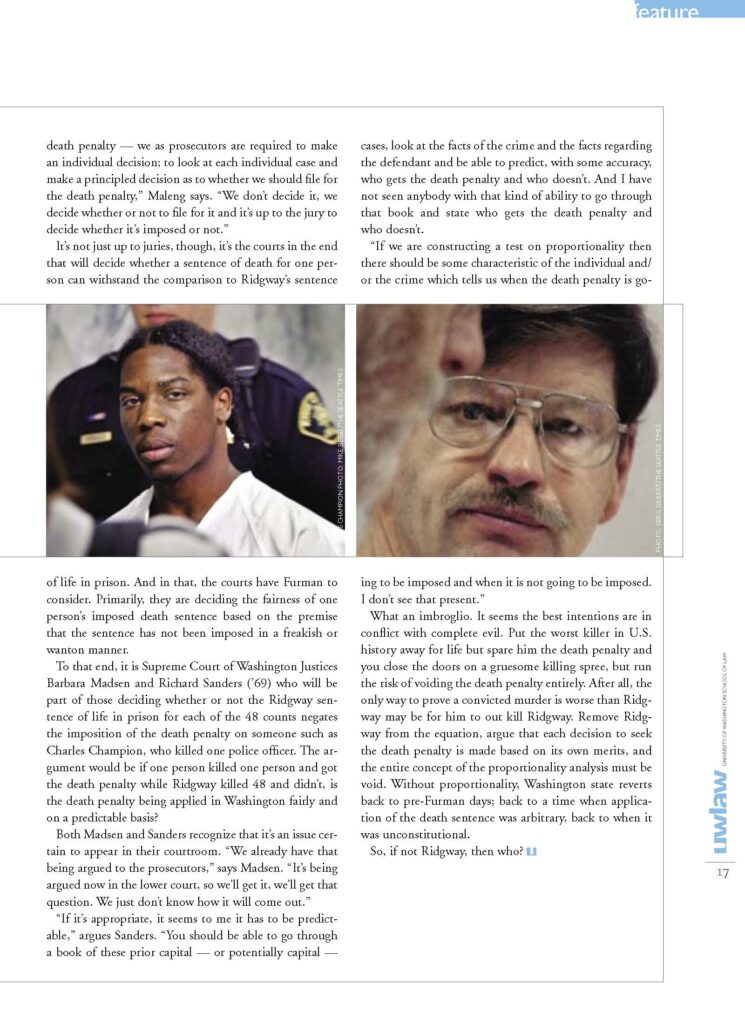
It’s not just up to juries, though, it’s the courts in the end. that will decide whether a sentence of death for one person can withstand the comparison to Ridgway’s sentence of life in prison. And in that, the courts have Furman to consider. Primarily, they are deciding the fairness of one person’s imposed death sentence based on the premise that the sentence has not been imposed in a freakish or wanton manner.
To that end, it is Supreme Court of Washington Justices Barbara Madsen and Richard Sanders (’69) who will be part of those deciding whether or not the Ridgway sentence
of life in prison for each of the 48 counts negates the imposition of the death penalty on someone such as Charles Champion, who killed one police officer. The argument would be if one person killed one person and got the death penalty while Ridgway killed 48 and didn’t, is the death penalty being applied in Washington fairly and on a predictable basis?
Both Madsen and Sanders recognize that it’s an issue certain to appear in their courtroom. “We already have that being argued to the prosecutors,” says Madsen. “It’s being argued now in the lower court, so we’ll get it, we’ll get that question. We just don’t know how it will come out.”
“If it’s appropriate, it seems to me it has to be predictable,” argues Sanders. “You should be able to go through a book of these prior capital — or potentially capital — cases, look at the facts of the crime and the facts regarding the defendant and be able to predict, with some accuracy, who gets the death penalty and who doesn’t. And I have not seen anybody with that kind of ability to go through that book and state who gets the death penalty and who doesn’t.
“If we are constructing a test on proportionality then there should be some characteristic of the individual and/or the crime which tells us when the death penalty is going to be imposed and when it is not going to be imposed. I don’t see that present.”
What an imbroglio. It seems the best intentions are in conflict with complete evil. Put the worst killer in U.S. history away for life but spare him the death penalty and you close the doors on a gruesome killing spree, but run the risk of voiding the death penalty entirely. After all, the only way to prove a convicted murder is worse than Ridgway may be for him to out kill Ridgway. Remove Ridgway from the equation, argue that each decision to seek the death penalty is made based on its own merits, and the entire concept of the proportionality analysis must be void. Without proportionality, Washington state reverts back to pre-Furman days; back to a time when application of the death sentence was arbitrary, back to when it was unconstitutional.
So, if not Ridgway, then who?
1. IN 1972 THE UNITED STATES SUPREME COURT VACATED JUDGMENT IN FURMAN V. GEORGIA DECIDING THE EXACTION OF THE DEATH PENALTY VIO-LATED THE EIGHT AND FOURTEENTH AMENDMENTS, WHICH JUSTICE STEW-ART STATED COULD NOT TOLERATE THE INFLICTION OF THE DEATH PENALTY “UNDER LEGAL SYSTEMS THAT PERMIT THIS UNIQUE PENALTY TO BE SO WAN-TONLY AND SO FREAKISHLY IMPOSED.” 2. AS OF 1981, IN WASHINGTON STATE WHENEVER A PERSON CONVICTED OF AGGRAVATED FIRST-DEGREE MURDER IS SENTENCED TO DEATH, THE SENTENCE MUST BE REVIEWED ON THE RECORD BY THE SUPREME COURT OF WASHINGTON. 3. DURING SENTENCE REVIEW, THE COURT SHALL DETERMINE WHETHER: THERE WAS SUFFICIENT EVIDENCE TO JUSTIFY THE DEATH SENTENCE; THE DEFENDANT WAS MENTALLY RETARD-ED; THE SENTENCE WAS BROUGHT THROUGH PASSION OR PREJUDICE; THE SENTENCE OF DEATH IS EXCESSIVE OR DISPROPORTIONATE TO THE PENALTY IMPOSED IN SIMILAR CASES, CONSIDERING BOTH THE CRIME AND THE DEFENDANT. 4. SIMILAR CASES MEANS ALL CASES IN WHICH A PERSON IS CON-VICTED OF AGGRAVATED FIRST-DEGREE MURDER. 5. IN NOVEMBER 2003, GARY RIDGWAY — THE GREEN RIVER KILLER — PLED GUILTY TO 48 COUNTS OF FIRST-DEGREE AGGRAVATED MURDER. HE HAS BEEN SENTENCED TO LIFE IN PRISON WITHOUT THE POSSIBILITY OF PAROLE.









About Post Author
