
Searching for Rainier
Published in Travel Tacoma.
Moss. Spring seeping up. Then pine, wet stone, and glacial dust being washed downstream. Summer arrives, exploding with the yellow scent of wildflowers and drying earth.
Fall is all leaves, evergreen, and a world of mycology fruiting. It is downed needles and duff so sweet that when you return home from a hike with the dog, you want to bury your face in her fur to absorb the smell. It’s the nectarine scent of chanterelles, and—if you’re lucky—cinnamon. Red Hots, to be exact, the candies my mother put on top of cupcakes when I was a child. This is from a matsutake, the elusive mushroom that hides beneath moss-covered forest floors, smells like cinnamon, and tastes like rain washed off a pine bough.
I have traipsed Mount Rainier’s higher-elevation wildflower fields around Paradise and stood agape at the giant trees that tower in the Grove of the Patriarchs, but it is the lower-level forests that truly beckon me. I have spent years clambering over logs, trudging up and down knotty hills, circling her base in search of mushrooms, bent over like some ascetic. The miles I’ve put on here might put summiteers to shame. Perhaps.
Spring and fall are when I first fell in love with the mighty Tahoma—as she was called by the area’s first inhabitants—if somewhat from afar. At 14,410 feet, Mount Rainier—a massive, active stratovolcano—is the tallest glaciated peak in the Lower 48.
For these reasons—the mountain’s height that rises far above the treeline, her massive glaciers, the towering ancient red-cedar forests far below—Mount Rainier often appears in a muted palette of color. Brown stick, green boughs, the slate of rock, and occasionally, the ruby crest of a bird—but she is a riot in smells. Even in winter, when pine disappears behind the brine of breath surging cold air, behind wet wool. Just beyond the smell of snow, though, rises something intangible. Sap. Pine sap, sticky and cold against bark.
I’m on snowshoes when I discover this, falling in love with Mount Rainier all over again. The plastic snowshoes clank beneath my feet as I slowly haul myself up steep slopes just south of the iconic peak, among North America’s largest no-fee hut-to-hut trail system—created and run by the volunteer-led Mount Tahoma Trails Association (MTTA)—a place even few locals know about. Here, 50 miles of trails access three huts and a yurt, each more than 4,000 feet above sea level. Which is why my hiking partners, Terry and her husband John, and I are planning on three days of ski-in, ski-out adventure.
It’s mid-January and even here, just beyond the southern edge of Mt. Rainier
National Park, the weather is unseasonably warm. On the one hand, this makes getting into the backcountry around Rainier easier—to get here we needed neither chains nor snow tires. It also means, however, that despite a scarcity of snow, much of the National Park is still closed to visitors. In winter, only two of the four visitor centers are open, though when there is snow, come weekends, ranger-led ski and snowshoe trips deliver the full glory of the mountain.
In the Snow-Park B lot at 3,400 feet, I open a bottle of Washington wine and empty it into a beat-up Nalgene bottle, then strap snowshoes onto my backpack. It’s so warm now that we dodge only the smallest of snowdrifts as we skirt the first trail gate and begin our ascent, our boots crunching across gravel. I’m a strong enough skier but a slow hiker, and now I’m worried that the distance will be too far, too steep, and that I’ll slog along and delay Terry and John.
And yet, I’m going uphill strong as we pass an enormous snowplow blade dangling from a cable. Going strong even when we stop, less than an hour in, for lunch. We perch on rocks under filtered sunlight. Terry and John smash hummus onto tortillas, and I polish off the enormous last half of a breakfast burrito. Turning around, we catch our first glimpse of a hut high upon a ridge behind us.
The main trail from here continues up to a saddle, but to our left, a narrower path dives into the woods. It is at this point that we make our first wrong decision. Worried we might run out of daylight, and wanting to ensure we get the best views, we reject the ungroomed Lower Yurt Trail where, we are told, there is a certainty of snow and we might have to scramble over a tree or two. Instead, we choose the well-traveled path. So, up and up and up we go across wet rocks and pockets of snow.
It’s close to 2pm by the time we reach the saddle. Already we’ve climbed 360 feet, and now we’re into soft, shallow snow. To the right, the trail turns into trees and ascends steeply toward High Hut. We turn left and begin the ascent to Snow Bowl and, beyond it, the yurt. All around the sky glows blue. Sun pierces the trees. It’s January, but it feels like April. Soon, we are on a small ridge and giddy to discover Mount Rainier bursting into view between the pines.
Another hour in, at about 4,360 feet, we meet Leyton. Even in gaiters and a felt hat, a pair of well-loved alpine touring skis jutting out from his pack, he’s the spitting image of John Malkovich. Leyton is just one of the many MTTA volunteers who build these trails, keep the cabins in shape, and organize searches when skiers and hikers don’t return from a trip. He asks where we’re headed and gapes in amazement to discover we chose this trail over the Lower Yurt Trail—a trail he built. He regales us with advice—how to turn on the stove in one cabin, where to collect snow for water at another—and then he’s off to ski in the backcountry, and we are off, too.
We pass the turnoff for Bruni’s Snow Bowl, stop, and pose for another glorious picture against a Rainier backdrop. Then, we work our way toward the yurt. It’s all uphill, downhill, breaking through soft snow in our hiking boots.
It is after 4pm, and we have covered 6.5 miles by the time we arrive at the yurt, set in a little clearing in the woods, steps from a majestic Rainier view. It’s rustic but not desperate, and a creek trickles merrily in the distance. Inside, we unpack and set to cooking dinner. I treat John and Terry to a decadent mac and cheese with smoked salmon, and braised greens. They treat me to wine and what must be a seven-pound birthday cake for John. We eat at 7:30 and are in bed by 9. From my spot on the top bunk I watch the stars shine through an oculus overhead.
Come morning we grab our daypacks, strap on snowshoes, and head out for a side trip. It takes us two hours to hike the 1.5 miles up to Mount Griffith viewpoint, where we take in panoramic views of Rainier in one direction, Mount St. Helens and Mount Adams in the other—the yurt a spec below. John scales a needle of rock while Terry and I speculate on where we’ve been and point to where we believe the trail is between the yurt and Bruni’s.
After lunch at the yurt, Terry and I strap on snowshoes for the hike to Bruni’s. While the snow isn’t deep, this is far easier than boot packing for us, although John—who hiked 2,155 miles of the Pacific Crest Trail over 109 days last summer—continues in boots. We stop to gape at the fresh upper palate of some bucktoothed creature strewn in the middle of the trail, then, at the intersection of our path and Lower Yurt Trail, we meet a hiker descending from Bruni’s.
“Whew,” he says, “I didn’t realize it was such a steep descent.”
Terry and I swallow hard and glance at each other. We hadn’t noticed it either, and now we’re steeling ourselves for what threatens to be a longer, harder climb than we had expected.
Yesterday’s sun has turned to an intermittent mix of sunlight and wet snow, but we still get peeks at the mountain and the bowls and valleys below. It’s only three miles between the yurt and Bruni’s Snow Bowl, set at 4,250 feet, but after descending nearly 500 feet the first mile, the rest is a gradual slog constantly uphill.
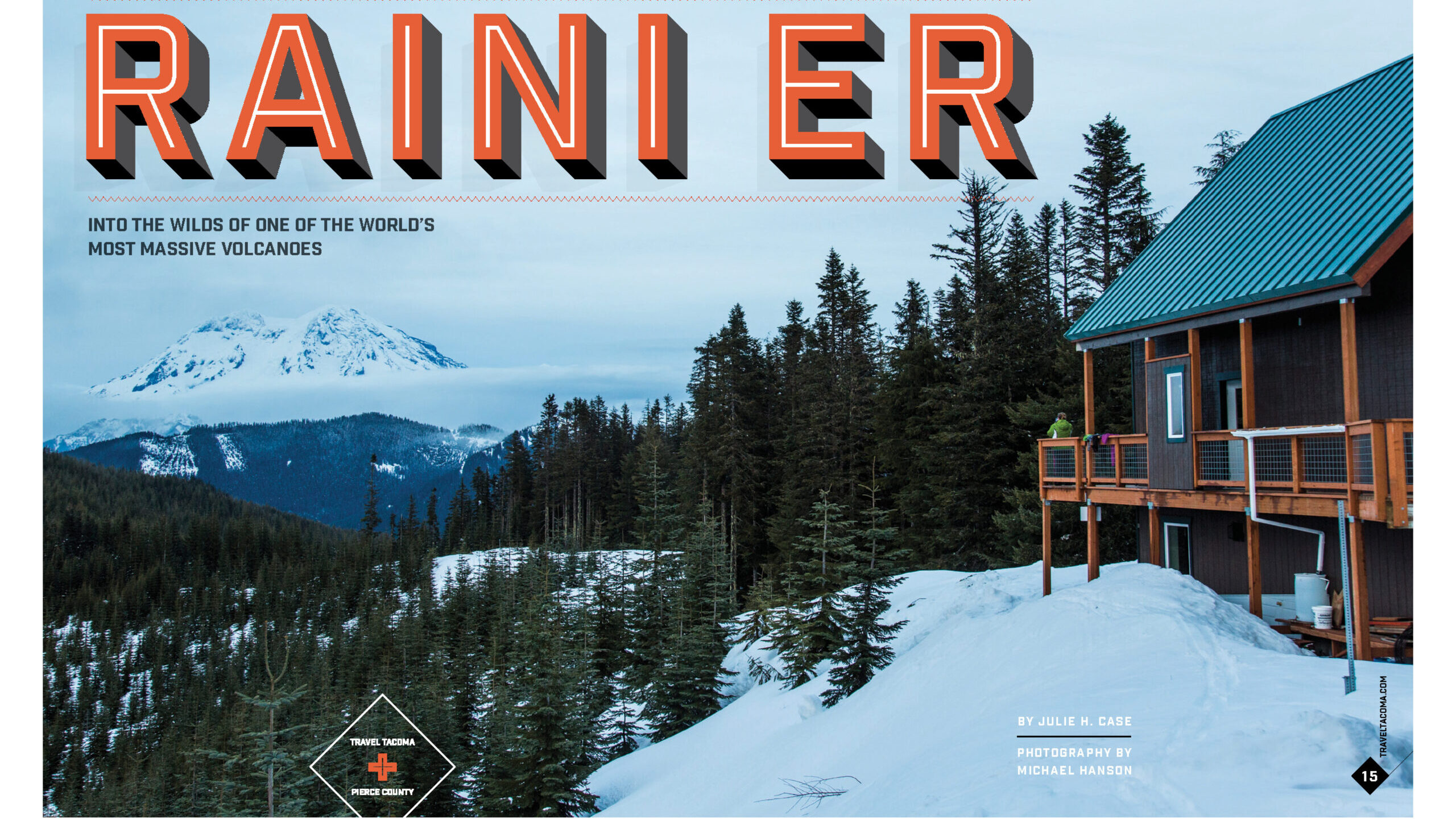
No matter. The trip is every breath worth it when we arrive at Bruni’s. It’s hard to call this a “hut.” Volunteers built it in 2012, after the original hut spontaneously burnt to the ground in March 2008. Now, three stories rise in a large bowl at the end of a hill—the basement dedicated space for volunteers and patrollers, a main room with a large kitchen and community space, and an open top-floor bunk room with a quiet space and dozens of mattress pads for floor sleeping. A wide deck wraps around the main floor. To the north is the grandest Mount Rainier view imaginable. She sits there, house size on the horizon, her slopes glowing pink in the sunset. To the west, past the bowls and glades and valleys, Puget Sound swims into view. Beyond that still, the Olympic Mountains rise against the skyline.
Snow Bowl is buzzing. Nearly a dozen female volunteers have descended on the cabin for the weekend—making 6-foot-4 John the only man for miles around. These are some of the coolest women I have met, including Bronka, a tiny, 87-year-old concentration-camp survivor, who summited Rainier 10 years ago in just one day. This year, she did it in two.
In the morning, we wake to rain, so instead of bidding John and Terry adieu and heading up to High Hut on my own, we all three retreat to the cars.
Luckily, the snow soon returns, and it’s just another month or so before I’m back in the mountains, a sullen mood evaporating with every labored breath. I’m getting better at this—at hauling myself up and up and up while awkwardly clad in snowshoes, pounds of gear and food on my back. I’d gotten a late start, leaving the parking lot an hour and a half later than I expected, and the snow has begun dropping in big, silent flakes around me. I’m not even a mile in when I realize that I’ve made another mistake: this time it’s snowshoes. Backcountry skis with skins would be faster going up, and so much more fun on the way down. Another reason to return.
Alone, I follow ski tracks through the snow, not stopping even when, just after a mile in, the temperature takes a first sudden plunge. By two miles in I’ve gained 660 of the 1,360 feet of elevation on this route to High Hut, which means I have another 700 feet to gain over the next mile. Then, with about a fifth of a mile to go, I reach what I estimate is the last turn. I’m out of the woods now, on a ridge high, high above everything else. As I make the turn, I expect High Hut to be right there.
But it’s not. Instead, the trail and ski tracks disappear. Snowdrifts undulate in waves. I screw up my courage—make a few wrong steps and they’ll find me in spring—and edge around
the first knoll. The hut still fails to appear. So I push on, circumnavigating one papery berm only to greet another. I step with caution. While these mounds don’t seem to be on a slope’s edge, I am hesitant to step onto anything that might collapse in a thundering avalanche.
Finally the hut appears, buried to the eaves in just five feet of snow. Michael, a Seattle photographer, comes out to greet me, and soon he, his girlfriend, Dani, and I are warming up with bourbon and epic views. A series of small ranges splays out below us. Beyond them, sun breaks the clouds, and pink God’s rays fall onto valley upon valley of snowcapped pines. From the north, wind sweeps in, carrying with it the icy whiff of hail as Mount Rainier makes the briefest of appearances before being consumed wholly by storm clouds.
It’s tantalizing: the mountains, the views, the air so crisp it tingles, and this chance to be high above it all so very easily. So compelling, that as I stand on the deck watching Mount Rainier play coy with the clouds, I begin mapping my return route for the summer.









About Post Author
